
The whole price index, used to measure rise in prices of a range of products in a consumer basket, stood at 9.06 per cent in May.
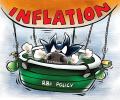
The Consumer Price Index (CPI)-based inflation is now projected to be at 5.3 per cent for 2021-22 with risks evenly balanced. In its August policy, the central bank had estimated inflation to be at 5.7 per cent due to supply side constraints, high crude oil and raw materials cost.

Industrial production re-entered the negative territory by contracting 1.6 per cent in January, mainly on account of the decline in output of capital goods, manufacturing and mining sectors. The output of the manufacturing sector -- which constitutes 77.6 per cent of the Index of Industrial Production (IIP) -- shrank by 2 per cent in January, as against a growth of 1.8 per cent during the same month last fiscal, as per data released by the government on Friday. The worst performance was witnessed by the capital goods sector, which recorded a contraction of 9.6 per cent during the month under review, compared to a 4.4 per cent decline a year ago.

There are glaring anomalies with Indian data and that could lead to wrong policy prescriptions.

Sources said Rajan will make the customary call on the Finance Minister on Monday, a day before he presents the policy.

With retail inflation witnessing significant uptick in May, the Reserve Bank of India (RBI) is likely to maintain status quo in its August monetary policy review, according to a report. According to the SBI's research report- Ecowrap, inflation may remain elevated in the coming months due to several global and domestic factors. "We expect a status-quo in August. We believe RBI would still try to find a marriage of convenience of regulatory and developmental measures and monetary policy in August policy," the research report said on Wednesday.

Retail inflation inched up to 4.48 per cent in October due to an uptick in food prices, government data showed on Friday. The Consumer Price Index (CPI) based inflation was at 4.35 per cent in September and 7.61 per cent in October 2020.

The Reserve Bank will hold a special meeting of its rate-setting committee on November 3 to prepare a report for the government on why it failed to keep retail inflation below the target of 6 per cent for three consecutive quarters since January. The six-member Monetary Policy Committee (MPC) headed by RBI Governor Shaktikanta Das will prepare the report on reasons for failure to meet the inflation target as well as the remedial measures the central bank is taking to bring down prices in the country. "Under the provisions of Section 45ZN of the Reserve Bank of India (RBI) Act 1934... an additional meeting of the MPC is being scheduled on November 3, 2022," RBI said in a statement on Thursday.

Enthused by higher than expected GDP numbers in the fourth quarter of 2022-23, Chief Economic Adviser (CEA) V Anantha Nageswaran on Wednesday said India's economic growth may exceed the initial estimate of 6.5 per cent in the current fiscal and the country can look for another year of solid economic performance.

It is unlikely that the RBI will drop rates until the inflation rate drops below five per cent.

The government hopes of registering GDP growth rate ranging between 6.1-6.7 per cent in 2013-14.

Vegetables and fruits have weights of 1.74 per cent and 2.11 per cent, respectively, in the wholesale price index.

'The actual price of petrol is Rs 35 and it jumps to Rs 88 because of government taxes.'

The finance ministry expects a broad-based moderation in inflationary pressures on the back of an anticipated reduction in food prices as a result of the uptick in summer sowing. The retail inflation rate remained stubbornly clung to the 5 per cent mark in seven of the past eight months. "Core inflation is trending downwards, indicating a broad-based moderation in price pressures... Driven by strong domestic growth and benign global commodity prices, core inflation is declining continuously.

Inflation rate during August, the data for which is yet to be released, was likely to remain at about 7 per cent, said SBI Ecowrap.

The index is currently trading at 149 per cent of its historical P/B valuation, surpassing its previous peak of 125 per cent made in 2020-21.

The current situation offers an opportunity for farmers to reinvest in agriculture.

While FMCG companies lose Rs 98,928 crore in m-cap, consumer durables stocks are down Rs 20,673 crore since November 8.

Also says PSU banks divestment to be considered after improvement in governance

To cut interest rates, the central bank head has to open up a debate on inflation target revision.

The inflation in the food basket spiked to 7.89 per cent in October 2019 as against 5.11 per cent the preceding month.

Among top losers that dragged down key indices were Infosys, TCS, Reliance, SBI, Tata Steel and ITC, falling up to 2.15 per cent.
Investors will keenly watch US Fed meet starting Tuesday

'Yet the market didn't do all that badly because it was cushioned by domestic inflows.'

The wholesale price-based inflation rose for the second consecutive month in February to 4.17 per cent, as food, fuel and power prices spiked. The WPI inflation was 2.03 per cent in January and 2.26 per cent in February last year. After witnessing months of softening of prices, the food articles in February saw 1.36 per cent inflation. In January it was (-) 2.80 per cent.
.jpg)
The Indian rupee touched record low of 65.52/dollar on Thursday and is down 16 per cent so far this year despite efforts by policymakers to prop it up.

Retail inflation rises to 4.41% in Sep on dearer food items
.jpg)
As on Monday, the prices of many vegetables had fallen as much as 50% compared with those a month before, due to increased supply, following the arrival of winter crops in the markets.

The US Fed's rate cycle is set to turn later this year, but India is in a much better position than it was in 2013.

Global trends, macroeconomic data announcements and the start of the earnings season would be the major drivers for the equity markets in a holiday-shortened week, analysts said. Equity markets will remain closed on Thursday for Eid-Ul-Fitr. Trading activity of foreign investors, rupee-dollar trends and crude oil prices would also guide trends in markets.

'Whether I am optimistic or pessimistic is not the issue; I am just going by the evidence available.' 'The Indian economy and financial sector are now well-placed and very resilient in dealing with any kind of spillover coming from the external world.'

The forecast of deficient monsoon rainfalls scared farmers.

RBI targets to keep inflation at 4 per cent, (+/- 2 per cent), and its rise beyond this comfort zone will put pressure on the central bank to hike rates.

The employment situation remains dire. Whatever can be done to promote greater low-skill employment should be pursued aggressively, advises former chief economic adviser Shankar Acharya.
Data suggests that households too are expecting inflation to subside, with the three-month-ahead and the one-year-ahead expectations declining by 40 basis points, reports Abhishek Waghmare.

Fruits, vegetables and eggs continued to witness deflationary trend during January this year, with their prices declining 4.18 per cent, 13.32 per cent and 2.44 per cent, respectively.

Government's push for Make in India which focuses on select 26 sectors and improving the 'ease of doing business' will aid the manufacturing/industrial growth.

Despite multiple headwinds at the start of 2023, the Indian markets delivered a strong performance, posting 19-20 per cent growth for the year. Even as new records were set, investor sentiment remains strong going into 2024, given the lower inflation, expectations of steady to lower interest rates, higher economic growth, and strong inflows. However, the overriding concern for most brokerages is valuations.

India is likely to grow by 7.5 per cent in the first quarter of the current financial year, driven by rising aggregate demand and non-food spending in the rural economy, according to an article in the RBI's May Bulletin released on Tuesday. The Indian economy has demonstrated marked resilience in the face of geopolitical headwinds impacting the supply chain, said an article on the state of the economy published in the May Bulletin.

If the pattern over the last three months is going to continue, the likelihood is that both indices will register inflation rates close to current levels over the next few months.
